There’s a phrase I’ve heard in almost every marketing team I’ve worked with.
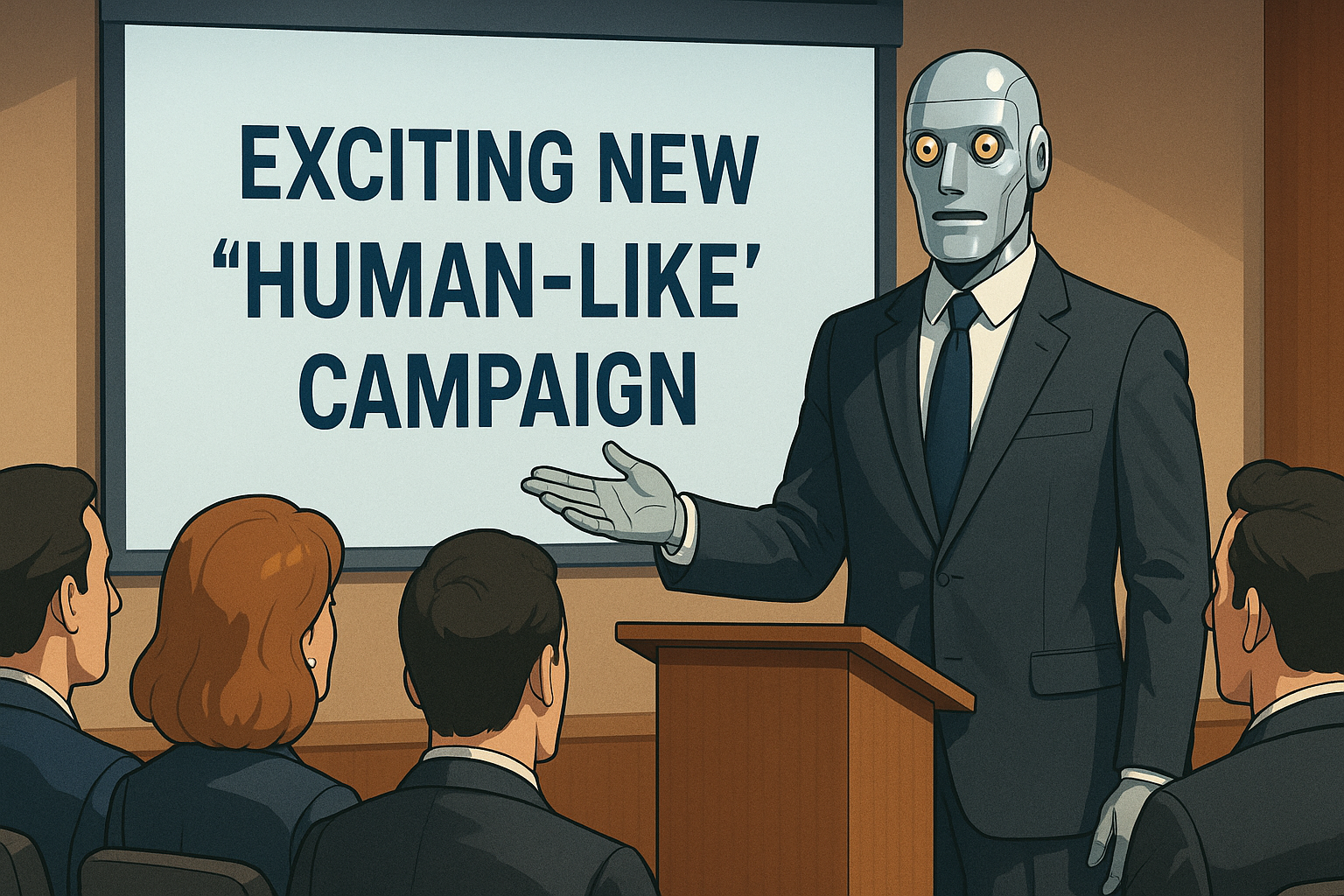
“Let’s move that for phase two.”
I’ve said it myself.
Sometimes it’s valid. Often, it’s not.
More often than we’d like to admit, “phase two” is where bold ideas go to die. Not because they were bad ideas, but because they made people uncomfortable. They forced decisions. They carried risk. And risk is something modern organisations are very good at avoiding.
Marketing hasn’t become uncreative. It’s become risk-averse by design.
When Safety Becomes the Strategy
Most marketing today isn’t built to create impact. It’s built to avoid blame.
That shows up in familiar ways:
- Approval chains that reward consensus over conviction
- Campaigns watered down to satisfy every stakeholder
- “Best practice” used as a shield instead of a guide
- Bold ideas deferred until “we’ve proven it works”
The problem is that this safety-first approach rarely delivers safety. It delivers forgettable work, slow momentum, and strategies that look good in decks but struggle in the real world.
McKinsey has consistently shown that organisations with faster, higher-quality decision making outperform their peers. When decisions stall in layers of consensus, performance drops.
https://www.mckinsey.com/capabilities/people-and-organizational-performance/our-insights/decision-making-in-the-age-of-urgency
Marketing is no exception.
Boldness Without Strategy Is Just Noise
This is where the conversation usually goes wrong.
This is not an argument for reckless creativity.
This is not “be bold for the sake of it.”
Boldness without strategy is just noise.
I’ve seen plenty of grand ideas that ignore commercial reality, operational constraints, or clear business goals. Those ideas fail too. Often faster.
Real boldness is earned. It sits on top of:
- Clear business objectives
- An understanding of constraints
- A point of view about what matters and what does not
- A willingness to accept trade-offs
Michael Porter defined strategy as choosing what not to do. Strategy is about trade-offs by definition. It is uncomfortable because it requires commitment.
https://maaw.info/ArticleSummaries/ArtSumPorter96.htm
If your marketing strategy does not force uncomfortable choices, it probably is not a strategy. It is a summary.
Strategy Without Courage Is Just Theatre
The opposite problem is just as common.
Smart strategy. Clear insights. Strong rationale.
And then nothing happens.
This is where “phase two” quietly enters the room.
Strategy without courage becomes performance. It creates the illusion of progress without the risk of commitment. The work exists, but only in documents, not in decisions.
Harvard Business Review has repeatedly shown how matrixed organisations struggle with accountability. When everyone owns a decision, no one really does.
Marketing teams feel this deeply. Ideas die not because they are wrong, but because no one is willing to stand behind them.
The Real Role of Marketing Leadership
Good marketing leadership is not about choosing between safety and boldness.
It is about knowing when boldness is justified, and when it is not.
That judgement does not come from frameworks alone. It comes from experience, context, and an understanding of how the business actually operates.
Data should inform decisions, not replace them. Attribution models, dashboards, and performance metrics offer a narrow view of a much larger system.
McKinsey research shows that fewer than 40 percent of organisations consistently make decisions that are both high quality and high velocity. Data is part of the picture, but never the whole picture.
https://www.mckinsey.com/capabilities/people-and-organizational-performance/our-insights/decision-making-in-the-age-of-urgency
Judgement still matters. Context still matters. Courage still matters.
Why Conservative Businesses Still Need Bold Marketing
Some businesses are genuinely conservative. Regulated industries. Legacy brands. Complex B2B environments.
That does not mean boldness is off the table.
It means boldness looks different.
Boldness might be clarity instead of creativity.
It might be focus instead of expansion.
It might be saying no to ten things to do one thing properly.
Research from the Ehrenberg-Bass Institute shows that brands grow through consistency, mental availability, and long-term investment. That does not mean playing it safe. It means being deliberate and memorable.
https://marketingscience.info/news-and-insights/the-very-long-and-the-short-of-it
Boring marketing is not conservative marketing. It is usually fear wearing a business case.
When “Phase Two” Is Actually Valid
Sometimes parking an idea is the right call.
If the foundations are not there.
If the business cannot support it operationally.
If the timing is genuinely wrong.
But “phase two” should be a decision, not a reflex.
If you cannot articulate what needs to be true for that idea to move forward, then it is not a phase. It is avoidance.
Final Thought
Marketing has not lost its creativity.
It has lost its willingness to make decisions.
The work that cuts through sits at the intersection of strategy and courage. Not one without the other.
Boldness without strategy is noise.
Strategy without courage is just theatre.
The hard part is knowing the difference.